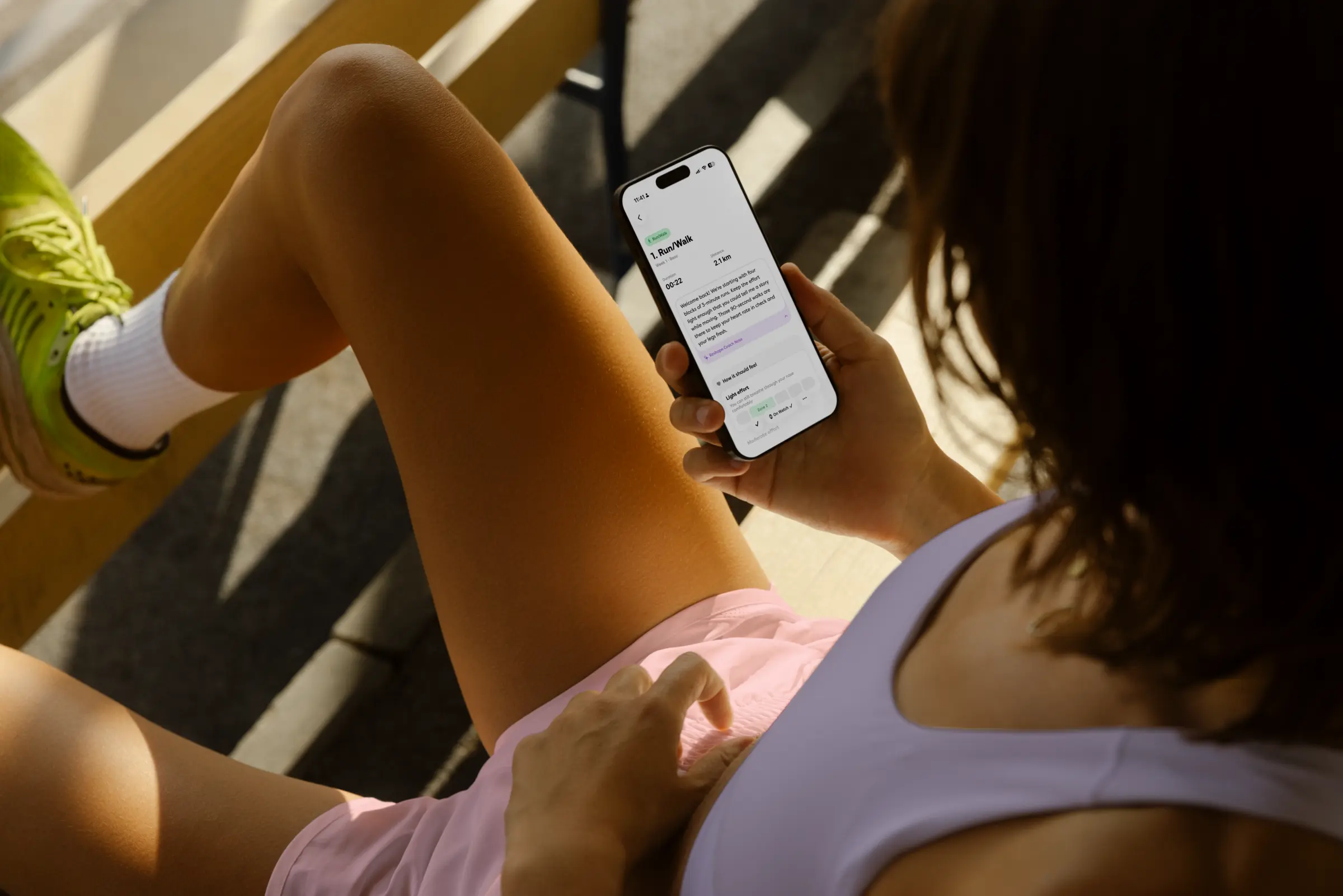
If you want a 5K plan that actually adapts to your week, Reshape is built for that job. It reads your Apple Health history, starts at the right week, and regenerates the next seven days from the runs you just did. Three or four runs a week, one harder session, the rest easy. Free during the TestFlight beta.
How the plan works
A 5K is a short race on paper, but the preparation has to do a lot of work in a small number of weeks. Reshape organizes that work across three phases. A base phase builds aerobic capacity through easy-paced running and a single harder session a week. A build phase layers in 5K-specific intervals and tempo efforts. A peak and taper phase sharpens the race pace and pulls volume back so you arrive on race day with fresh legs.
The pacing comes from Jack Daniels’ VDOT tables, which translate your current race-equivalent fitness into actual target paces for easy runs, threshold work, and intervals. The periodization comes from the same base, build, peak, taper structure coaches have used for decades. The only thing that’s new is the weekly regeneration: the plan reads what you actually ran, updates your current VDOT, and composes the next week inside those training-science rules.
That matters more in a short block than a long one. A 5K block only has a handful of hard sessions. Missing one and pushing it into next week’s load is how runners end up injured with two weeks to go. Reshape doesn’t do that. If you miss a session, the next week recalibrates rather than compounds.
Three 5K runners this plan fits
- First-timers.If you’ve never raced a 5K, the plan opens with walk-run intervals and short easy distances paced to what your body can handle today. Every workout comes with a plain-language coach note so you see why the session exists.
- Comeback runners.If you’re coming back from a gap or an injury, Reshape reads your recent Apple Health data and starts where your fitness actually is, not where it was before you stopped.
- PR chasers.If you’ve run 5Ks before and want a time, give the plan your goal and your race date. The block is periodized, the intervals are paced by current VDOT, and the taper is built in.
What a 5K week is built around
In a 5K build-phase week there are three kinds of work, and the plan balances them so the hard days sit at least 48 hours apart. You’ll see:
- One interval session. Short reps at 5K-to-10K effort that raise your ceiling. Paces are composed from your current VDOT, not a fixed target time.
- One threshold or tempo effort. Sustained time at the pace you could hold for about an hour. This is the engine that makes 5K pace feel less maximal.
- One long easy run. Conversational pace. Recovery-first, not volume-first. In a 5K block this stays relatively short.
- One or two easy runs. Short, recovery-paced. They exist so the hard days can actually be hard.
Reshape composes the specific session lengths, paces, and rep structures from your current fitness and the week you’re in. You see the workout on your Apple Watch the night before. A plain-language coach note on each session explains why it’s there.
Built on what you already ran
- Your VDOT, not a guess. Reshape pulls your recent race-pace and easy-pace efforts from Apple Health and scales every interval to your current VDOT. No onboarding quiz trying to imagine your fitness.
- Interval splits on your wrist. Every 5K session lands on your Apple Watch the night before. Reps, rest, and target pace per rep are on the face while you run.
- Catches a bad week before taper. A 5K block has a handful of quality sessions. If one week goes sideways, the next week recalibrates instead of stacking the missed load onto taper week.
An example 5K build-phase week
Week five of an eight-week block, for a runner training three to four days. Paces and interval lengths shift with your current VDOT; the shape stays roughly this.
| Day | Session | Coach note |
|---|---|---|
| Day 1 | Rest or easy cross-training | Quality sessions need clean legs. |
| Day 2 | 6 × 800 m at 5K effort, 2:00 jog recovery | Raises your ceiling. Pace comes from current VDOT. |
| Day 3 | 30–40 min easy | Recovery-first. Conversational effort. |
| Day 4 | Rest | Protect the quality of the weekend session. |
| Day 5 | 20 min threshold, 5 min easy out and back | Pace you could hold for an hour. Engine-building. |
| Day 6 | Optional short easy | Only if legs feel good. Rest is a valid choice. |
| Day 7 | 45–60 min easy long run | Aerobic base. Finish the week strong, not shredded. |
This is a representative week, not a fixed template. Your real plan starts at a different volume, uses your current pace zones, and rewrites each week from the runs you completed.
Reshape isn’t the right pick if…
- You want a human coach in the loop. Reshape is software only.
- You want audio-led runs during the workout itself. Take a look at Nike Run Club for coached audio sessions.
- You only want Android or a web dashboard. Reshape runs on iPhone, with Apple Watch optional.
Common questions
It depends on where you start. A runner who already jogs two or three times a week can race a 5K in four to six weeks of structured training. A true beginner who can’t run continuously yet is better served by the dedicated couch-to-5K plan, which opens with walk-run intervals and takes eight to twelve weeks. Reshape reads your Apple Health history so the plan starts at the right week instead of assuming you’re further along than you are.
Three to four runs in a week, with one harder session and the rest easy. A typical structure is one interval or tempo session, one easy run, and an optional longer easy run on the weekend. The rest of the week is rest or cross-training. The harder session is where fitness gets built; the easy runs are what lets you absorb it without breaking down.
An iPhone running iOS 18 or later. That alone is enough to follow the full plan: every 5K session shows up in the app the night before, with paced intervals, audio cues, and a coach note. An Apple Watch is optional. If you wear one, the same workout lands on your wrist with target paces and haptic cues for each rep. Either flow works.
The next week regenerates around what actually happened. If you missed three runs in a row, Reshape won’t pile the missed mileage on top of the week ahead. It recalibrates to the fitness you have now and rebuilds from there. Missing a week doesn’t break the plan.
Yes. The engine uses Jack Daniels’ VDOT pacing, so interval and tempo paces are scaled to your current fitness rather than a target time you can’t hit yet. Give Reshape your race date and goal; it builds a periodized block (base, build, peak, taper) and adjusts the intensity week by week from the runs you actually complete.