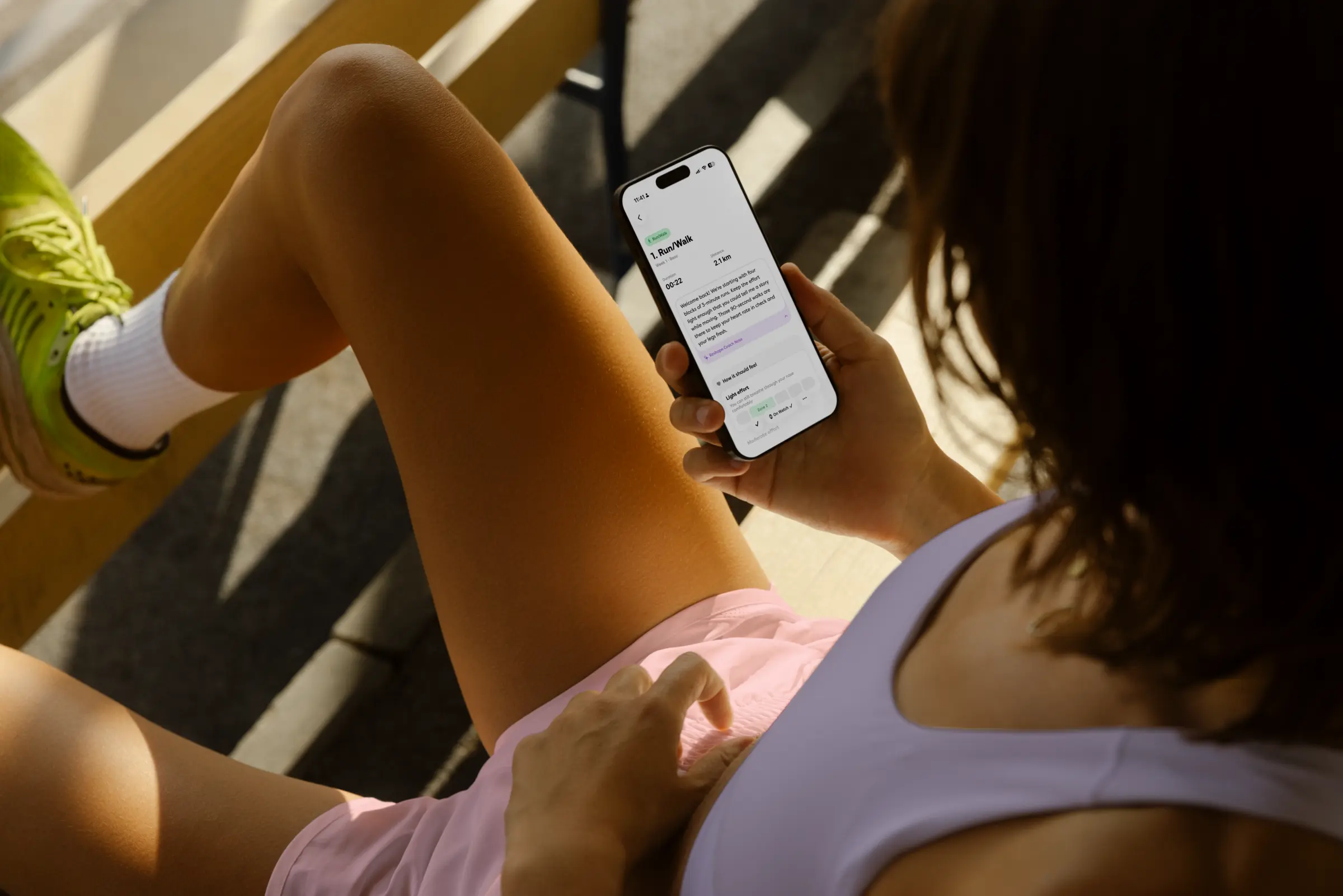
The hardest part of marathon training isn’t the long run. It’s making the whole block survive a cold, a work week, a bad night’s sleep, a week your body just won’t cooperate. Reshape treats those weeks as signal, not noise. The plan regenerates from what you actually did, so one rough week stays one rough week.
Before you start a marathon block
Sixteen weeks is the training block, not the whole journey. This page is written for runners who are already training consistently and have either run a half marathon in the past year or cover somewhere around forty to fifty kilometres a week of regular volume. If that’s you, you’re ready to begin.
If it isn’t, sixteen weeks of marathon training is not the right answer. The honest path from zero is closer to a year, not four months: couch to 5K, then a 10K block, then a half marathon, then this. Each step earns the next one; the volume of a marathon block can’t land safely on legs that haven’t built for it.
Not at the starting line yet? Begin where your body is: couch to 5K, 10K, then half marathon. Reshape reads your Apple Health and carries your fitness forward from one block to the next.
Sixteen weeks in three phases
Weeks 1–6: Base
Mostly easy mileage, one weekly threshold session, and a long run that extends one step at a time. Here the plan asks your body to get efficient at burning fuel aerobically and to tolerate the volume a marathon block is about to ask of it.
Weeks 7–12: Build
The long run stretches toward race distance. Threshold work lengthens. Some long runs end with a real stretch at marathon pace so your body learns what that effort feels like on tired legs. This is where the marathon gets built; it’s also where most injuries happen in blocks that don’t know to pull back.
Weeks 13–16: Peak and taper
The highest-quality sessions live here, then volume drops sharply in the final two to three weeks so you arrive rested. The taper is built in. Reshape won’t let you cram one last big long run the week before race day even if you want to.
Three marathoners this plan fits
- First marathon. The goal is the finish line, healthy. The plan prioritizes gradual long-run extension, caps week-to-week increases, and keeps quality work modest. Finishing is the job; a time is a bonus.
- Chasing sub-4, sub-3:30, sub-3. Give the app a race date and a target. Intervals and threshold paces are scaled to your current VDOT, the block is periodized, and weekly regeneration catches bad weeks before they compound into a failed peak.
- Training around life. If the sixteen-week block has to flex around a work trip, a conference, a sick kid, Reshape reads what you actually ran and rebuilds from there. The taper still lands on race day, just built out of different weeks.
What a marathon week is built around
A build-phase marathon week typically includes five or six days of running. Inside a typical week:
- One threshold session. Sustained time at the pace you could hold for roughly an hour. Marathon performance is strongly correlated with how much of your race pace sits below threshold.
- One interval session. Short, fast reps at 5K-to-10K effort. These keep the top end sharp so marathon pace feels controlled.
- One long run. The centerpiece. Extended each week within a cap. Some long runs finish with a segment at marathon pace once the aerobic base is there.
- Two or three easy runs. Short, conversational, protecting the quality of the hard days and adding aerobic volume.
The specific session lengths, interval counts, and paces are composed by Reshape from your current VDOT and where you are in the block. A strong week adds load carefully. A rough week pulls back. Long-run increases are capped so you can’t jump into injury territory.
Built on what you actually ran
- Reads recovery, sleep, and HRV. Across sixteen weeks your body goes through every version of tired. Reshape reads recovery signals from Apple Health and pulls back when sleep debt or elevated resting HR says it should.
- Marathon-pace segments on the wrist. Long runs with a marathon-pace finish ship to your Apple Watch with the segment boundary and target pace ready to trigger from the face.
- Protects the taper. The final two to three weeks are locked. No rogue late long run, no last-minute quality session. You arrive to the start line rested, not scrambling.
- Caps long-run jumps across the block. Week-to-week long-run changes sit inside a firm cap. A missed long run doesn’t turn into a 40 km overcorrection the next week.
An example peak-build marathon week
Week twelve of a sixteen-week block, for a runner training six days. Paces come from your current VDOT; the long-run distance is set by the previous week inside a cap.
| Day | Session | Coach note |
|---|---|---|
| Day 1 | Rest | Marathon blocks live on honest rest days. Take it. |
| Day 2 | 3 × 2 km at threshold, 2 min jog between | Engine. Sustained pace close to an hour effort. |
| Day 3 | 50 min easy | Recovery-first. Nose-breathing pace. |
| Day 4 | 6 × 400 m at 5K effort, 90 s jog recovery | Top-end sharpness. Keeps marathon pace feeling easy. |
| Day 5 | Rest or easy cross-training | Legs decide. Reshape reads the data and picks. |
| Day 6 | 40 min easy shakeout | Prime for tomorrow. No intensity whatsoever. |
| Day 7 | 30 km long run, last 8 km at marathon pace | Race rehearsal. Final block before taper week fires. |
Representative only. Your plan uses your current pace zones, your real weekly availability, and rewrites each week from the one before.
Reshape isn’t the right pick if…
- You want a human coach in the loop. Reshape is software only.
- You want strength programming bundled in. Reshape is running-only. Runna has a library for that.
- You train on Android, Garmin, Coros, or Fitbit. Reshape runs on iPhone, with Apple Watch optional.
Common questions
Sixteen weeks is the standard marathon training block, and that assumes you already have a base: consistent running, ideally a half marathon in the past year, and around forty to fifty kilometres a week of regular volume. If you’re newer than that, sixteen weeks is not a shortcut. The honest total from zero is roughly a year — couch to 5K, then a 10K block, then a half, then the marathon block. Reshape reads your Apple Health so it can tell where your base actually is and roll you through the blocks in sequence.
The long run. It's where marathon-specific fatigue resistance gets built. Reshape grows the long run gradually across the block, caps the week-to-week increase so you don't jump into injury territory, and in the build phase occasionally finishes a long run with a stretch at marathon pace. A typical peak long run for a first marathon sits at 28–32 km; for PR-chasers it can go a little longer.
Four to six for most runners. First-time marathoners do well at four days; more experienced runners chasing a PR typically need five or six. Reshape asks how many days you can run and builds the week around that number, rather than forcing a fixed schedule. The emphasis is on getting the long run and one or two quality sessions done, not on hitting an arbitrary day count.
Either iPhone or Apple Watch records the session — Reshape reads whichever flow you use through Apple Health. iPhone in a belt or armband works for the full distance, with audio cues at every segment. Modern Apple Watches sit comfortably inside a four-hour long run with GPS and heart rate on; for anything beyond that, switch to Low Power Mode before the session starts. Either way the plan reads the completed run and shapes next week from it.
Yes. Give the app your race date and a target. Intervals and threshold sessions are paced from your current VDOT, not from a number you picked on a calculator. As your fitness changes across the block, Reshape re-estimates your VDOT from the runs you actually complete and updates the next week’s paces. The taper is protected and real, not a three-day token.