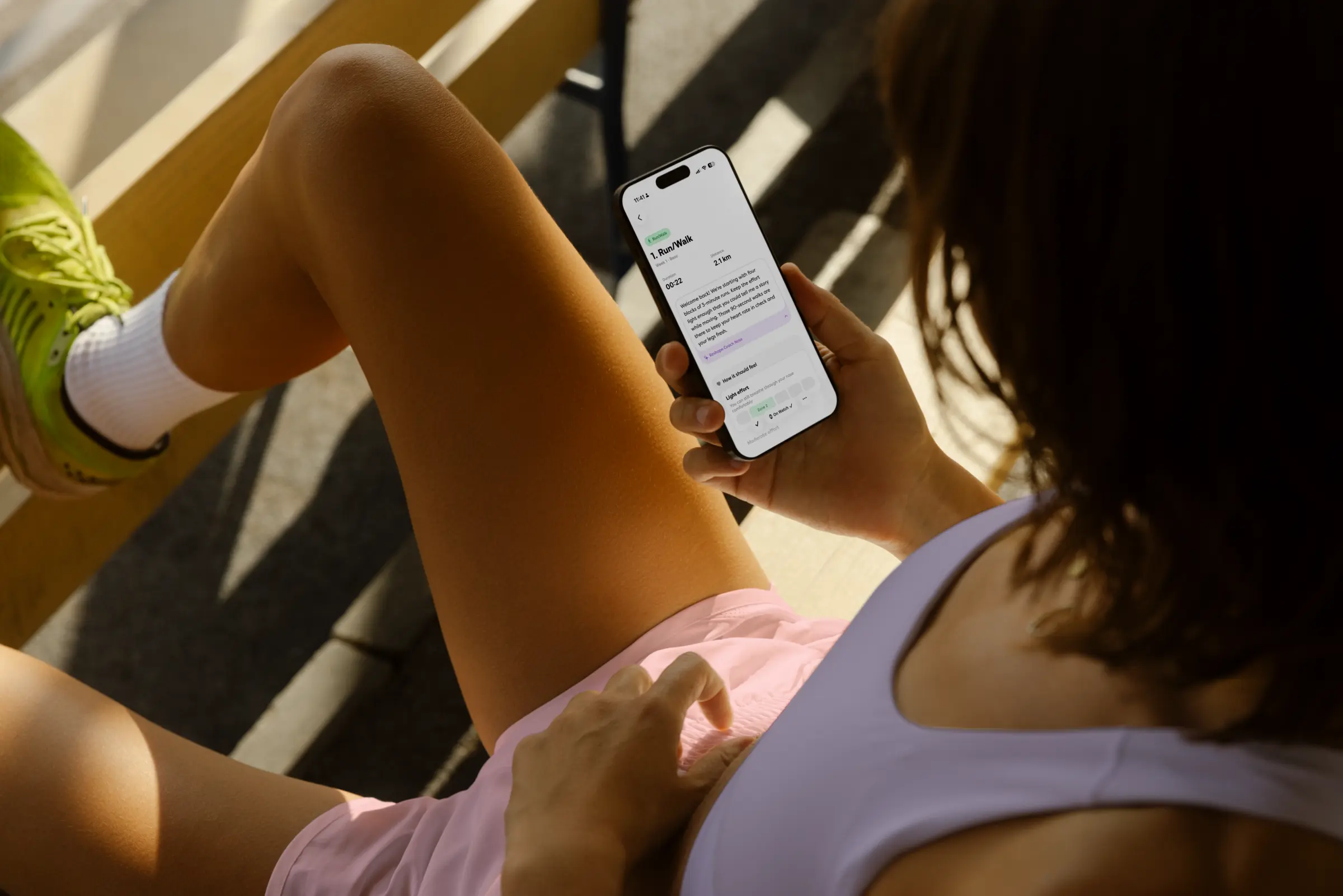
A half marathon rewards runners with a stable aerobic engine and a threshold pace they can hold for roughly 90 minutes. Reshape’s half plan builds both across twelve weeks, grows the long run at a cap that protects you from overreaching, and rebuilds each week from the runs you actually logged.
Before you start a half marathon block
Twelve weeks is the training block, not the whole journey. This page is written for runners who can already run a 10K comfortably and are training three or four times a week at somewhere around thirty kilometres a week. If that’s you, you’re ready to begin.
If you haven’t reached a consistent 10K yet, the honest route is shorter first and longer second. Each step earns the next one; stretching a half plan doesn’t fix a missing base, it just puts the race day further out.
Not there? Start at couch to 5K or 10K, and roll into this block when your Apple Health data shows the base is there.
Twelve weeks in three phases
Weeks 1–4: Base
Mostly easy running, one weekly threshold session, and a long run that extends one step at a time. The job is aerobic capacity: making your body efficient at burning fuel at low intensity.
Weeks 5–8: Build
Threshold work gets longer, VO2Max intervals appear, and the long run stretches toward 18–22 km. This is where race-pace awareness starts. Some long runs end with a short segment at half-marathon pace so race day feels like something your body has practiced, not something it has to figure out in the moment.
Weeks 9–12: Peak and taper
The highest-quality sessions live here, then volume pulls back sharply in the final fortnight so you arrive rested. The taper is a real two weeks, not a three-day token one.
Three half-marathon runners this plan fits
- First half. If this is your first time racing the distance, the plan prioritizes getting to race day healthy. Long runs extend gradually. Threshold sessions are moderate. Finishing, not racing, is the job.
- Going sub-two, sub-1:45, sub-1:30. If you have a specific time in mind, Reshape uses VDOT to scale interval and threshold paces to your current fitness. The block is built around the race date and the taper is protected.
- Building toward the marathon. A good half is often the cleanest way to evaluate marathon readiness. The plan can roll into a marathon block once the half is done, carrying over your current VDOT and accumulated base.
What a peak half week is built around
A peak-phase half week typically has four or five days of running, balanced so the hard sessions have real recovery between them. Inside a normal week:
- One threshold session. Sustained time at the pace you could hold for roughly an hour. The strongest predictor of half-marathon performance for most runners.
- One interval session. Shorter reps at 5K-to-10K effort. These keep the top end sharp so race pace feels controlled.
- One long run. Grows across the block at a pace your body can absorb. Some weeks finish with a segment at race pace once the aerobic base is solid.
- One or two easy runs. Short, conversational, recovery-paced.
The specific paces, session lengths, and rep counts are composed by Reshape from your current VDOT and the phase of the block. A rough week pulls back; a strong week adds load carefully. Week-to-week load changes are capped so long runs never jump far enough to injure you.
Built on what you already ran
- Reads your long-run progression. Reshape tracks how your Sunday long run has extended across recent weeks in Apple Health and sets next week’s distance inside a strict cap. No 30% long-run jumps.
- Race-pace segments on your wrist. Long runs with a half-pace finish land on your Apple Watch the night before, with split times per segment so you know when to drop into race effort.
- Caps long-run jumps automatically. Week-to-week long-run increases are limited. A bad week pulls the long run back rather than piling missed kilometres onto the next Sunday.
An example peak-phase half marathon week
Week nine of a twelve-week block, for a runner training five days. Paces come from your current VDOT; the specific long-run distance is set by the previous week’s session.
| Day | Session | Coach note |
|---|---|---|
| Day 1 | Rest | Anchor the week. Full rest before Tuesday quality. |
| Day 2 | 4 × 1 km at 10K effort, 90 s jog recovery | Keeps the top end sharp. Race pace should feel controlled. |
| Day 3 | 45 min easy | Conversational pace only. Heart rate below aerobic cap. |
| Day 4 | 3 × 12 min threshold, 2 min jog between | Strongest predictor of your half time. Protect this session. |
| Day 5 | Rest or 30 min easy | Reshape checks recovery and picks. If in doubt, rest. |
| Day 6 | 40 min easy shakeout | Prime the legs for tomorrow. No intensity. |
| Day 7 | 20 km long run, last 6 km at half pace | Rehearse race day. Finish inside the cap, not outside it. |
Representative only. Your plan uses your current pace zones, your real weekly availability, and rewrites each week based on the previous one.
Reshape isn’t the right pick if…
- You want a human coach in the loop. Reshape is software only.
- You want strength and Pilates programming in the same app. Reshape is running-only. Runna has a library for that.
- You train on Android, Garmin, Coros, or Fitbit. Reshape runs on iPhone, with Apple Watch optional.
Common questions
Twelve weeks is the training block, and it assumes you’re already running consistently and can comfortably cover a 10K. If you can, twelve weeks is honest. Eight is possible if you already have a steady 40–50 km per week base. If you can’t cover a 10K yet, the right answer isn’t a longer half plan; it’s the shorter-distance path first: couch to 5K, then 10K, then the half block. Reshape reads your Apple Health and rolls your fitness forward when you’re ready.
For most runners preparing a half, the long run grows from around 10 km in early base to 18–22 km by late build. It’s run at a conversational pace. Occasionally the plan finishes a long run with 20–30 minutes at marathon or half-marathon pace once the base is solid. Jumping the long run more than about 20% week-to-week is the fastest way to pick up an injury; the plan caps that by default.
For a finish-time-first goal, anywhere from 35 to 60 km per week in peak weeks is common. First-timers can race a half at 30–40 km a week of mostly easy running. Runners chasing a PR usually sit at 50–80 km in peak weeks. Reshape caps week-to-week load changes so volume builds without spikes your body can’t absorb.
Every long run is ready in the app the night before with the distance, target pace range, and any race-pace segment laid out. Run it from your iPhone with audio cues for each segment, or from your Apple Watch if you wear one (same workout, paces on the face). Either source records the session, and once it syncs to Apple Health, Reshape reads the outcome to set the next week. If you ran a bit shorter than the plan asked, the next long run reflects that rather than ignoring it.
Yes, and this is one of the places a plan that reads your actual history helps. If Apple Health shows you’ve been doing a lot of short-interval work but not much volume, the early weeks focus on building easy aerobic minutes before the long run extends. The goal is to reach race day with a long run close to race distance and legs that have been protected from overreaching.