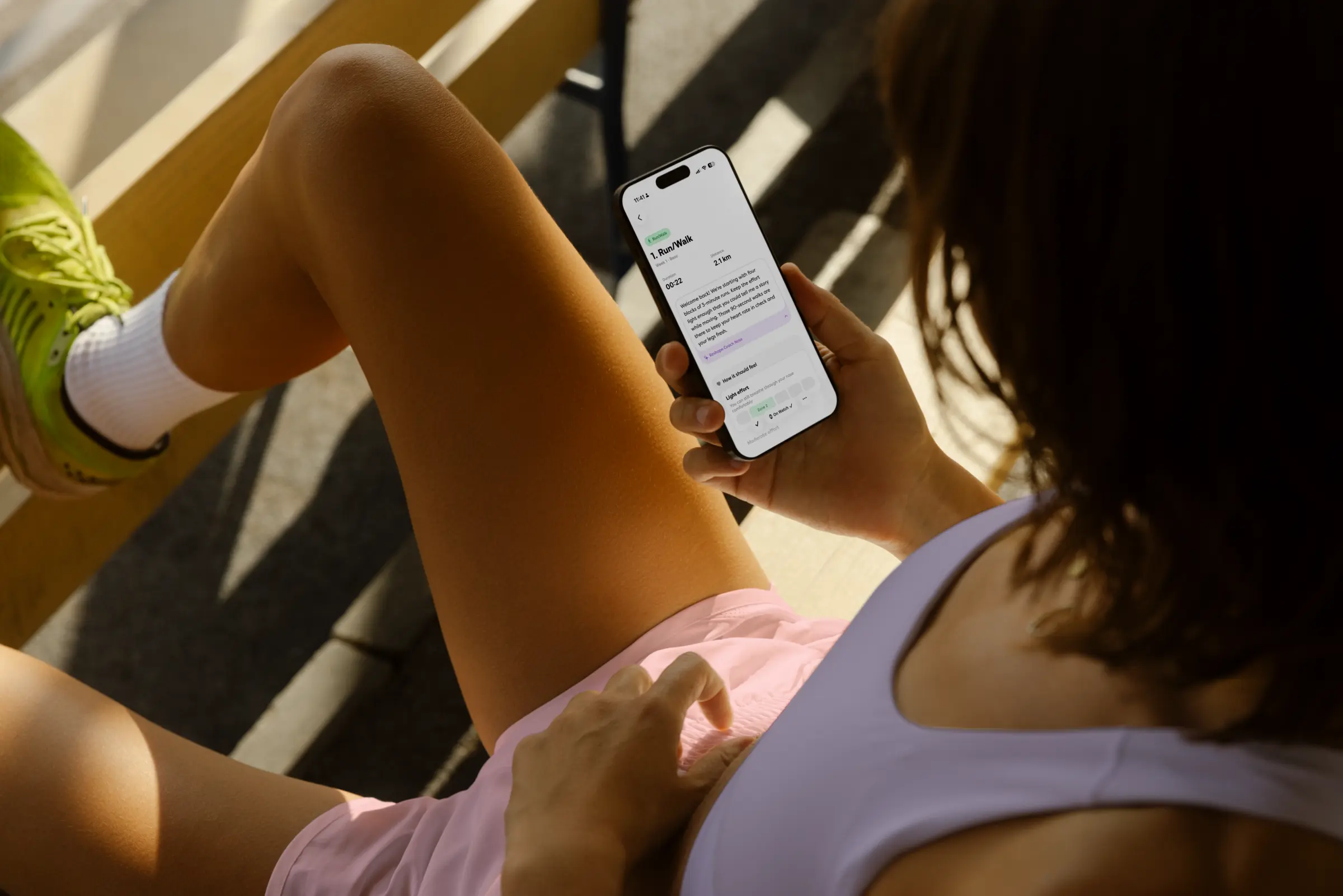
The most common injury cycle is this: you recover, you try to pick up where you left off, you break down again four weeks later. Reshape doesn’t let that happen. It reads your recent Apple Health, ignores the fitness you used to have, and caps the week-to-week increase so your return progresses without spikes.
How the return plan is built
The first phase is all easy running. Short sessions, conversational pace, frequency over duration. The body needs clean weeks of low-load work before intensity is safe to add. Reshape holds you there for as long as your data suggests you need to be there; not a fixed number of weeks.
The second phase adds a single weekly quality session. Typically a short threshold effort at first, then gradually longer as the block builds. Long runs extend on the weekend at a strict cap: no more than a small percentage of the previous week. If a week goes badly, the plan doesn’t try to catch up; it resets the progression honestly.
The third phase looks like a normal training block again, and that’s by design. Returns work when the first two phases have genuinely rebuilt the base. By the time a race goal enters the picture, your body has had months of clean weeks behind it.
Three return stories this plan fits
- A few months out. If a calf strain, shin splints, or a tendonitis kept you off running, the plan reads your current (low) baseline and starts from there. The progression is slow enough that the same injury is less likely to come back.
- Years out.If it’s been a long time, Reshape treats you as a new runner. The early weeks are walk-run intervals, and the plan builds from there the same way it would for someone starting couch to 5K.
- Post-race recovery overshoot. If you kept training hard after a marathon and your body called time on you, Reshape drops volume and intensity, holds you at easy-paced running, and only adds quality once the data shows you’ve absorbed the easy weeks.
What a return week is built around
A return week is deliberately lighter than a normal training block. Inside a typical early week:
- Three or four short easy runs. Conversational pace, moderate length, spread across the week with real rest between them.
- One slightly longer easy run. No intensity. The job is time on feet at an effort your body can absorb.
- Two or more full rest days. Rest is the active ingredient in a return block; Reshape protects it.
As clean weeks accumulate, the plan adds load and then a single quality session, and eventually looks like a normal training block again. The specific session lengths and paces are composed by Reshape from your current fitness and the week you’re in.
An example early return week
Week four of an eight-week return-to-running block, after three clean easy-running weeks. The goal is frequency and clean recovery, not distance. Your real plan scales the session lengths to your current baseline.
| Day | Session | Coach note |
|---|---|---|
| Day 1 | Rest | Rest is the active ingredient in a return block. |
| Day 2 | 25 min easy run | Conversational. Target heart rate stays below aerobic cap. |
| Day 3 | Rest or gentle cross-training | Cross-training is optional. Skip if anything feels off. |
| Day 4 | 25 min easy run | Same session as Tuesday. Consistency builds the base. |
| Day 5 | Rest | No optional runs this week. Protected rest. |
| Day 6 | Optional 20 min walk | Optional only. Walking is legitimate training here. |
| Day 7 | 35 min easy run | Slightly longer weekend session. No pace targets beyond easy. |
Representative only. If any session produces a twinge, log what happened and the next week pulls back instead of pushing through.
Why adaptive matters most on a return
- Fitness is a moving target. A return is the period in your running life when fitness changes most from week to week. Reshape re-reads your data weekly and re-scales accordingly.
- Capped progression protects you. Week-to-week load increases are limited. Long-run jumps are limited. Nothing in the plan is permitted to spike past what your body has shown it can handle.
- Rough weeks don’t compound. A missed week regenerates rather than stacking on the next one. A twinge pulls the plan back honestly instead of pushing through.
Reshape isn’t the right pick if…
- You need medical or physiotherapy guidance. Reshape is a training plan, not a medical tool. See a physio; come back to the plan when you’re cleared to run.
- You want a human coach supervising the return. Reshape is software only.
- You’re on Android or Garmin. Reshape runs on iPhone, with Apple Watch optional.
Common questions
When you’re cleared to run pain-free by whoever is treating you. Reshape is a training plan, not medical advice; it won’t tell you the injury has healed. Once you can run without pain, the plan starts you at a load your current fitness can absorb rather than the load you had before the injury.
It reads up to eight weeks of your running from Apple Health. If the past two months included a gap, the plan sees the gap. If you’ve only been walking, it sees that too. The starting week is set to match what your body has been doing recently, not what it used to do.
Two things. First, the starting volume is lower and grows more slowly, with tighter caps on week-to-week changes. Second, intensity is delayed. Hard sessions only appear once a few clean weeks of easy-paced running are in the books. A typical 5K or 10K plan ramps faster; a return plan deliberately doesn’t.
Log what actually happened, take the rest your body is asking for, and the next week regenerates from there. Reshape won’t stack the missed work on top of the week ahead. One cautious week is how returns survive; the plan defends that by default.
Yes, once you’re running consistently again. Reshape is happy to roll from a return block into a 5K, 10K, half, or marathon block. The transition is driven by what Apple Health shows your current fitness to be, so the race block starts from where you actually are, not where you hope to be.